Streaming
Komodrag & The Mounodor - Mama 2024-67 (C) THOMAS BARTEL
The digital economy has exploded; streaming has become the most dominant form of music consumption and it has revolutionized music listening. However, its foundations are deeply fractured. It has created a distortion where the streaming companies and record labels are able to benefit from this shift in consumption at the expense of those who create and perform the music. The streaming era has made the music industry an even more unsustainable, unfair and dysfunctional market.
Billion streams on various streaming platforms translate to musicians from no streaming income at all to a fraction of $0.003 to $0.005 per stream on average. How does something so widely enjoyed end up worth close to nothing for those who performed it? How are years of efforts degraded to pennies for streams?
As we speak, more than 78% of consumers get their music from some streaming platforms.
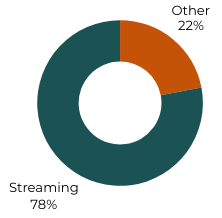
By 2024, the aggregated global revenue from music streaming services exceeded 20 billion US-dollars. And yet, even artists who have millions of listeners receive a pittance, and a most musicians receives nothing.
Featured artists can receive royalty from their record labels, but the amount that reaches the artist is usually very small due to low royalty rates and reductions. Musicians that do not have a royalty deal with the record label receive nothing from streaming.
Lesson Learned: Streaming is unsustainable for artists and musicians.

A solution has been found. Spain introduced a right to fair remuneration from streaming for music performers in 2007. AIE has been managing that right and distributes streaming royalties to over 30,000 artists and musicians every year. More recently, some other EU countries have introduced a similar right. An unwaivable right to equitable remuneration is the best way to ensure music performers receive fair recompense from streaming.